
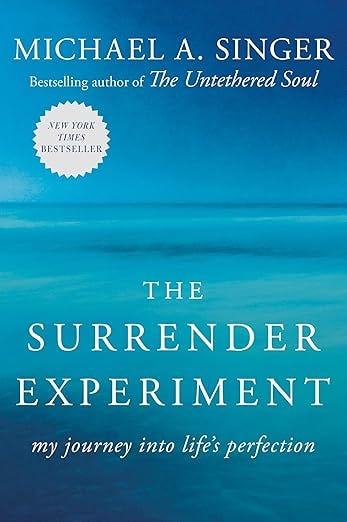
Book Review: "The Surrender Experiment"
Can enlightenment be found in an airport terminal?

Michael “Mickey” Singer’s memoir, the Surrender Experiment, is a familiar tale for the baby boomer generation: spiritual seeker turned life-long businessman. But unlike some along that path, Singer never forsook his spiritual roots, emerging from a long career with an intriguing spiritual philosophy for everyday life. His core idea is one that he re-emphasizes with admirable consistency and tenacity (if not repetitiveness) over the many anecdotes and life episodes that he shares. In short - one must surrender to the perfection of the flow of life, the primary means by which the divine communicates with us.
As Singer’s story opens, he relays his early steps on the spiritual path - practicing Zen meditation, encountering the teachings of his primary spiritual teacher, Paramahansa Yogananda (of Autobiography of a Yogi fame), and building a meditation center and temple in 1975. To support himself, he was first a college instructor, and then a homebuilder.

These years were filled with a series of seemingly miraculous coincidences which led Singer to develop the core of his spiritual philosophy. Simply put, the events of reality are the conduit through which the cosmic power of God flows.1 All we can do is align ourselves to or resist this flow. By opening our heart to life, and by putting aside personal preferences, the spiritual seeker is able to quiet the rational or discursive mind. As this is done, intuitive solutions to problems become self-evident. In this way, life itself becomes our best friend, teacher, and lover.
A good portion of the book is devoted to the story of building his practice management software business, Medical Manager, which would grow from a piece of software personally written by Singer in the 1980s to a multi-hundred-million revenue business within the WebMD conglomerate twenty years later. This episode is a living portrait of the practice of karma yoga - union with God through devotion to one’s work. Through these chapters, Singer makes it clear that his philosophy of surrender leaves no room for lethargy. Though keeping up his morning and evening meditation practices, he worked tirelessly through this period to write the best piece of software and build the best business that he knew how to do, as an offering to the universe which had given him this opportunity.
The element of surrender in this chapter of his life was to surrender his ideas of what he might otherwise be doing - perhaps traveling the world, and teaching as a spiritual guru, although he doesn’t quite mention the potential alternatives - in order to devote himself to the task at hand. As he did this, he found himself supported by what he called an “inner spiritual energy flow” to match the outer flow of events. As I’ve heard this related in a Christian frame - God only gives the grace to complete one’s duties in the moment, and not before.
The book reaches a crescendo with the story of his indictment by the federal government on charges related to alleged accounting fraud at Medical Manager. It was a truly dramatic episode, kicked off with an FBI raid of the author’s offices in 2003 and only concluding in 2010 with the charges against him and others dropped, after a cumulative $190 million in legal fees were spent.2 Here is where the rubber on his path of surrender truly meets the road. It was moving to hear him describe his development of a deep love for the American Constitution and legal system during this time, rather than become embittered through this chapter. To the contrary, he writes his first bestselling book during this time, the Untethered Soul. In his telling, it was his final and greatest test in letting go of his ego’s desires - the thing that he had prayed for God to help him do, many years prior.3
Are we similarly willing to use the purifying fires of life’s challenges for self-transformation? If we are, challenging situations will create the force needed to bring about positive change in one’s life. In Singer’s words, if you are able to weather the winds of a great storm, absorbing them like water that stirs and then stills without a trace, you may find in the storm’s wake that a beautiful gift has appeared on your shores.
As it relates to my own life, I have certainly seen the power of surrender at work, even if some of the anecdotes I would relate do not have the dramatic nature and timing of the ones that Singer shares. My observation has been that you can either solve your own problems, or you can enlist life’s help in solving them. If you go with the latter, which can be the only option, it’s critical to have Singer’s sense of surrender about the way in which that resolution comes about.
If all of the above sounds intriguing, I would definitely recommend the book.4 The technique is powerful and has endless depth to it, as illustrated by the range of experiences that Singer relates in the memoir. For further explorations on the topic of surrendering to the divine flow, I recommend the book “Outrageous Openness,” by Tosha Silver. For a less surrender, more “work with” approach, I also recommend Patrick Dunn’s “The Practical Art of Divine Magic.”
Hermetic cabalists will note the similarity with attuning one’s consciousness to the pillar of mercy on the tree of life.
Be careful what you wish for.
I’m thankful to my friend Will who referred this book to me.
Wow!! A great essay on being in the moment and focusing on the task at hand, needed this! 🤍