
The Astral Plane
Richard Feynman vs. the cargo cults

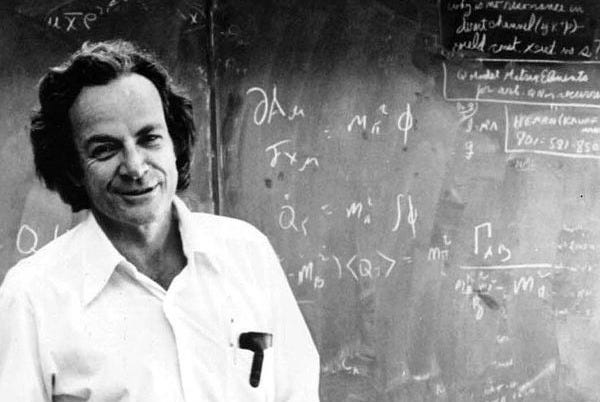
One of the all-time great graduation speeches has to be the 1974 Caltech commencement address by the quintessential American physicist, Dr. Richard Feynman. It is a stirring tribute to that jewel of human achievement, the discovery of the scientific process, and an admonishment to graduates to adhere to it carefully. He contrasts faithful conformity to the principles of the scientific process with something he terms Cargo Cult Science:
In the South Seas there is a Cargo Cult of people. During the war they saw airplanes land with lots of good materials, and they want the same thing to happen now. So they’ve arranged to make things like runways, to put fires along the sides of the runways, to make a wooden hut for a man to sit in, with two wooden pieces on his head like headphones and bars of bamboo sticking out like antennas—he’s the controller—and they wait for the airplanes to land. They’re doing everything right. The form is perfect. It looks exactly the way it looked before. But it doesn’t work. No airplanes land. So I call these things Cargo Cult Science, because they follow all the apparent precepts and forms of scientific investigation, but they’re missing something essential, because the planes don’t land.
While the speech is a masterpiece, I always had the hunch that Feynman was somehow being unfair to this particular group of Melanesians. Certainly no group of people would persist in such a pattern of behavior for decades without a sufficiently compelling reason to do so. And as it turns out, they did have one. Not one that Feynman would consider scientific, but a very interesting one nonetheless, and one that provides an illustration of that famous esoteric doctrine of the astral plane.
Over thirty years after Feynman’s commencement speech, in 2006, a reporter for Smithsonian magazine traveled to Vanuatu to investigate one particularly famous cargo cult which remained alive and well, the cult of a legendary American G.I. named John Frum.
This is February 15, John Frum Day, on the remote island of Tanna in the South Pacific nation of Vanuatu. On this holiest of days, devotees have descended on the village of Lamakara from all over the island to honor a ghostly American messiah, John Frum. “John promised he’ll bring planeloads and shiploads of cargo to us from America if we pray to him,” a village elder tells me as he salutes the Stars and Stripes. “Radios, TVs, trucks, boats, watches, iceboxes, medicine, Coca-Cola and many other wonderful things.”
The piece was a sympathetic and illuminating portrait of a people who had endured seismic cultural shifts - first, encounter with European culture via Captain James Cook in 1774, after which colonization and repression of native culture ensued, and then, the Second World War, where indeed as Feynman described, cargo planes had landed carrying a dizzying display of American material splendor.
After the war, the cargo planes ceased, and colonial subjugation continued. Things had returned to how they were before, but something had shifted. The promises of abundance and prosperity associated with the Western way of life had been answered - but from an unexpected source. Not the British and French authorities, but an American military aiming to supply its war efforts in the Pacific theater.
With the end of the war, colonial promises now rang hollow. The people of Vanuatu had seen the prosperity that had been promised, and knew that the colonial authorities were either unable or unwilling to provide it. Worship of John Frum provided a potent counterpoint - a god, real or not, which had asked nothing from the people, and certainly not to sacrifice their own culture. They would accept nothing less. The cargo cults would go on to play a powerful political organizing role, leading to the eventual independence of Vanuatu in 1980.
Though the cargo cults were rebelling in part against a Christian missionary structure, their inspiration echoed the forces from millennia earlier that drove the very birth of that religion, pioneered by one who also rejected the authority of the political establishment to dictate a person’s relationship with God. The Smithsonian article concludes by exploring this parallel.
As we look down into John Frum’s fiery Tanna home, I remind him that not only does he not have an outboard motor from America, but that all the devotees’ other prayers have been, so far, in vain. “John promised you much cargo more than 60 years ago, and none has come,” I point out. “So why do you keep faith with him? Why do you still believe in him?”
Chief Isaac shoots me an amused look. “You Christians have been waiting 2,000 years for Jesus to return to earth,” he says, “and you haven’t given up hope.”
Esoteric doctrine holds that the astral plane is a realm of myths, symbols and images, one that is not subject to time. In the words of the Roman writer Sallustius, “things that never happened but always are.”
Being timeless, there are no forces of erosion and corrosion that happen on the astral plane. The march of time does not take its toll, as it does on physical bodies. An unfulfilled promise can persist for 60 years, or 2,000, if there is sufficient motivation to keep its hope alive. There’s a coherence to it, a Schelling point, which is hard to dislodge. When change comes, it comes apocalyptically, in the original Greek sense of the word, “an unveiling.” In the process of a myth being fulfilled, paradoxically, the myth itself must die - because its lack of fulfillment is a constitutive component of the myth itself. The art of sustaining, sidelining, supplanting, fulfilling or replacing a myth has been the practice and secret of priests and statesmen through the ages.
Indeed, Dr. Feynman was engaged in this art in his commencement speech. A sermon designed to evoke the spirit of scientific progress in the hearts of all who heard it, an ideal which can never be fully fulfilled or perfected but which can always be sought. True to the dynamics of the astral plane, as it was in 1974, so it is today. The ideal societies envisioned by Dr. Feynman, by Christians, by the followers of John Frum remain ever on the horizon. And yet, the lives their adherents live continually and day by day shape the world we live in. “You will know them by their fruits.”
Wow, I never thought about how belief systems, whether scientific or spiritual, can both stem from the same human longing for meaning and order. What do you think drives that need most? Hope, fear, curiosity? All of these? Great read!