
The Spiritual Offside Flag
Overcoming the subject/object divide

Much of my reading time in 2021 was spent puzzling through the German idealists of the late 18th and early 19th centuries. While it didn’t produce immediate enlightenment, it did allow me to further appreciate one of the great Monty Python sketches, the Philosophers’ Football Match.
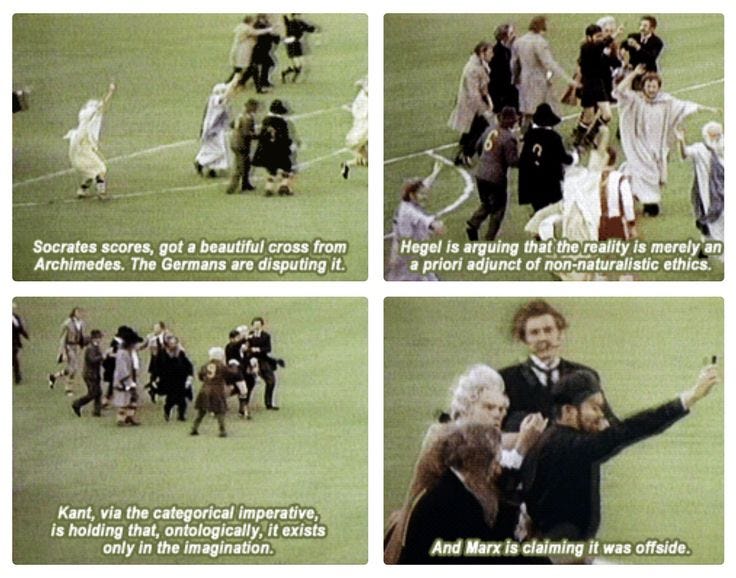
Their relevance has come back around, though, as I’ve been reading the Philosophy of Freedom, an 1894 book by the Austrian thinker Rudolf Steiner. His work, much like the German idealists preceding him, was in part a reaction to Kant’s intellectually convincing but ontologically distressing conclusion that we can know nothing of “things-in-themselves,” only appearances. Steiner’s response is that thinking is a unique category of phenomena which can be known directly, unlike sensations of the external world or even feelings, because it necessarily precedes even the subject/object division of “myself and an external world.” For Steiner, thinking is the pre-eminent spiritual activity. (Still not a license to have a wandering mind in meditation.)
As we continue to grapple with how to approach the spiritual world from a philosophical perspective, Steiner’s work represents a seemingly fruitful anchor point, addressing as it does the subject/object split which is the bane of the spiritual search. One masterful treatment of this is the series of articles by the writer Ashvin aptly titled “On Attaining Spiritual Sight.” The argument put forth is that we need to examine our thinking not only for its rational content but also to discern the invisible spiritual structures that shape it:
this invisible structure is first reflected in everything we normally conceive of as our stream of thoughts, beliefs, expectations, and desires, and at a slightly deeper scale, as sympathies and antipathies which steer our soul states in one direction or another, toward pleasure and away from displeasure (physical and psychological). We need to remember, that in our ordinary consciousness, we only have mental pictures of these soul constraints and those pictures cannot be confused for the constraints themselves. The latter are rather the invisible ‘geodesics’ along which our entire lives are normally dragged into various ‘gravity wells’, as individuals and collectives.1
This is not an easy thing to do, but is the sort of self-awareness that is promoted by the Christian practice of confession of one’s sins, as well as the esoteric practice of the construction of the soul mirror. The point is not to over-fixate on the individual datapoints surfaced by this practice, but to allow our “non-sense perception” to create from them an intuitive gestalt of our soul’s condition, and the forces which have been expressing themselves through our thoughts (and likely also, our feelings and actions). This intuitive perception is our true spiritual offside flag, the same thing that tells us whether a creative piece of ours is faithful to the aim which we set out to embody,2 or whether our efforts in the domains of work or sports have lived up to our standards. It is the only faculty that can tell us whether our life’s pursuits are noble or folly - no outside source can answer this for us.
In taking on such a point of view, it is also seen how our desire to maintain “private thought-islands,” and even to question whether our fellow humans share the same type of experience that we do, is not a serious philosophical stance but rather an aggravated case of motivated reasoning.
The only thing preventing [us] from directly perceiving the spiritual experiences of others is the failure to ‘get up and move’, i.e. to take an active and loving interest in the ideas, goals, feelings, and impulses which animate these other perspectives.3
In all of this practice, the ego returns to its rightful place, playing the role of a true concept in Steiner’s philosophy - something that relates our perceptions back to the whole of life. Not a thing that puffs itself up against all else, but also, not a thing to be eliminated entirely - for then, who would be left to celebrate the goals?
From part three of “On Attaining Spiritual Sight”
As David Lynch said, “If you stay true to the idea, it tells you everything you need to know, really.”
Really appreciate how this frames thinking as both a spiritual activity and a compass for self-awareness. The metaphor of invisible ‘geodesics’ especially struck me, it makes me reflect on the unseen currents that shape my own choices!